
In learning strategy work, there’s a tension we don’t always name: the pressure to be polished versus the need to explore. But impactful learning lives in the messy middle, where play and process create space for deeper growth.
That’s not just true for children but for us, too.
Fred Rogers said,
“Play is often talked about as if it were a relief from serious learning. But for children play is serious learning. Play is really the work of childhood.”
And I’d argue—it’s the work of adulthood, too.
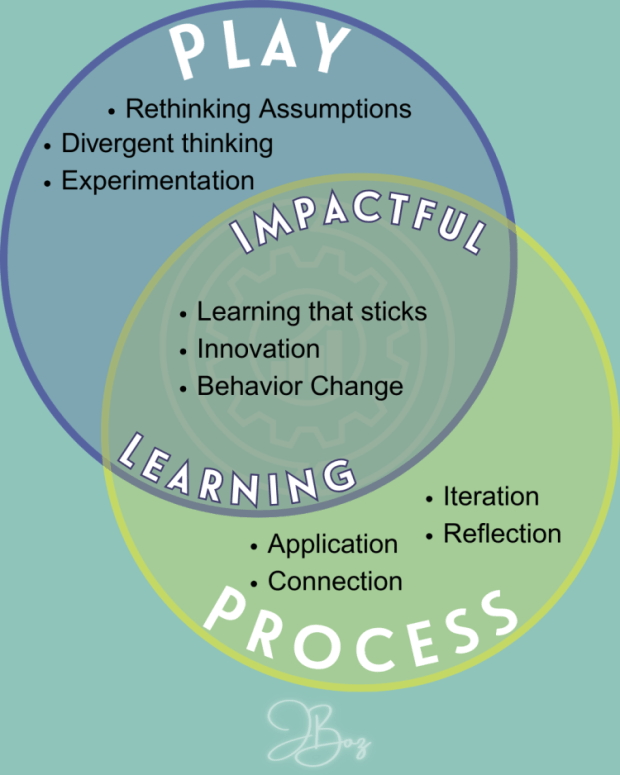
I don’t mean ping-pong tables or cheesy icebreakers when I talk about play. I mean the thinking that pushes boundaries and invites exploration.
The kind that asks:
👍 What haven’t we tried yet?
❓What if we challenged our assumptions?
🏃🏻♀️Could this “failure” be a starting point instead of an end?
⚒️What happens if we dig into discomfort instead of avoiding it?
Play, in this sense, is about divergent thinking, creative experimentation, and reframing what doesn’t work into something that might.
It’s what opens the door to critical thinking and adaptive problem-solving.
Ultimately, that’s how real learning happens, not through polish but through exploration and process.
One of the best examples from brainstorming efforts? The “lousy idea” list.
It’s easy to treat that list as a discard pile, but it’s actually an invitation.
It’s a space to ask, what’s here that could still work? Sometimes, the magic is in the reframe. A lousy idea needs the right constraint or the right problem to solve. But you only get there if you’re willing to play.
⚙️And the same goes for the process side of this theme.
The ability to learn doesn’t come from content alone.
It comes from how people move through it and what they do with it. How they reflect on it, reshape it, and wrestle with it.
🪴Strategy isn’t just about what gets built, it’s about how we create the conditions for people to experiment, iterate, and grow.
So when we talk about play and process in learning strategy, it’s not fluff. It’s foundational.
If we want learning to lead to real behavior change, we must create the space and structure for people to think, try, and connect.
That’s how learning sticks, and that’s how innovation happens.
It’s not polish that makes the difference.
It’s movement.
🧠 How do you make space for exploration in your work?
I’d love to hear how you use play and process in your learning strategies.
Or share your favorite childhood toy or game in the comments! I loved my wooden marble run blocks! I could build with those for hours!
#LearningStrategy #WorkplaceLearning #PerformanceEnablement #PlayAndProcess #LearningDesign #CriticalThinking #LearningThatSticks
 Jennifer Bosworth's Portfolio