
Sometimes you don’t realize your brain is building something until you see the shape of it from the other side.
A few years ago, I attended a conference and hit it off with a fellow attendee. We’ve stayed in touch and meet periodically to catch up, discuss professional matters, and support each other. I genuinely think of her as a mentor and a friend. At one point in our regular conversations, she suggested that I read Switch by Chip and Dan Heath. I was hooked. Their storytelling and metaphors spoke to me, and I began seeing the elephant and the rider at work. This book helped me ask better questions and think through situations with an adjusted lens.
My friend and I chatted about the book and decided we’d start reading one together and discuss it during our regularly scheduled chats. Two of the other books we read were Drive by Daniel Pink and Atomic Habits by James Clear. Just like with Switch, I found myself reframing life and work based on what we had read and discussed. We continued to read other books, but that’s not what this post is about.
After using what I’d learned at work, in my personal life, and in conversations with colleagues, I realized something surprising. These three books had been talking to each other in my head the whole time. As I continued to share insights from each one, whether with friends, colleagues, or myself, I began to see them in new, unexpectedly overlapping ways. Like parallel universes weaving together into a coherent way of thinking about behavior, motivation, and change.
The Pattern I Didn’t Know I Was Following
Each book stands on its own. But together?
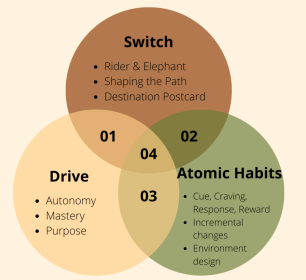
- Switch gave me the change-management metaphor: The Rider, the Elephant, and the Path—how logic, emotion, and environment tug at our ability to change.
- Drive gave me the fuel: Autonomy, Mastery, and Purpose—what truly motivates us.
- Atomic Habits gave me the engine: Cues, Cravings, Responses, and Rewards—how habits really work.
At first, I didn’t see it. But as time went on, I found myself mentioning concepts from each of these books in a single conversation. Together, they gave me a new, ever-changing lens on work and life. For those of you, like me, who wear glasses, you’ll understand this: these three books were the lens flips that an optometrist does when sorting out your prescription. The whole “which is better, 1 or 2” routine. There are many clear moments, and a single flip changes how you see the letters on the wall. These three books became those flips and dial turns. Suddenly, a situation or conversation came into clear view by layering concepts from the Heaths’, Pink’s, and Clear’s books. I don’t know that I’d call it a framework, but it became a curious plaything of my brain as I worked and lived.
At work, I’d find myself asking: What part of this challenge is really an Elephant problem? Later, while working with a teammate, I wondered if their lack of follow-through was actually a cue or an environmental misalignment. And when leaders were asked about why a group of colleagues was resistant, I heard myself saying my favorite quote from Switch: “What looks like resistance is often a lack of clarity” (p. 15). In short, I’d say: Look in the mirror. Have you given the team clarity on their goals or your request? Do they have a destination postcard? Are their Elephant and Rider in sync?
In 1:1 meetings with my boss, I often found myself weaving concepts from all three books into a single conversation. She suggested I share this with my colleagues during one of our monthly “Share Shop” sessions, and thus, Driving Atomic Elephants was born.
Driving Atomic Elephants
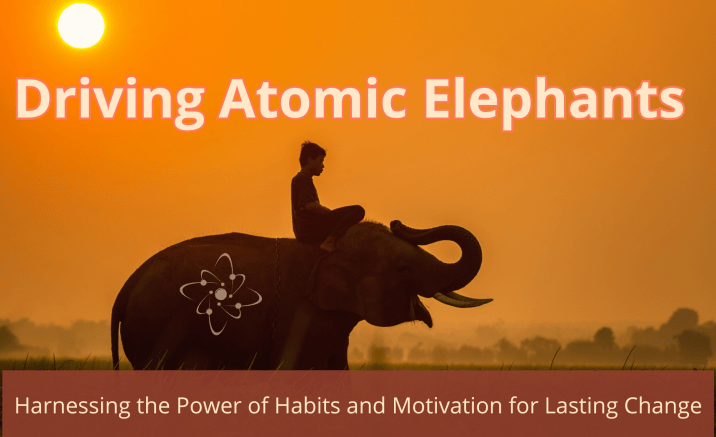
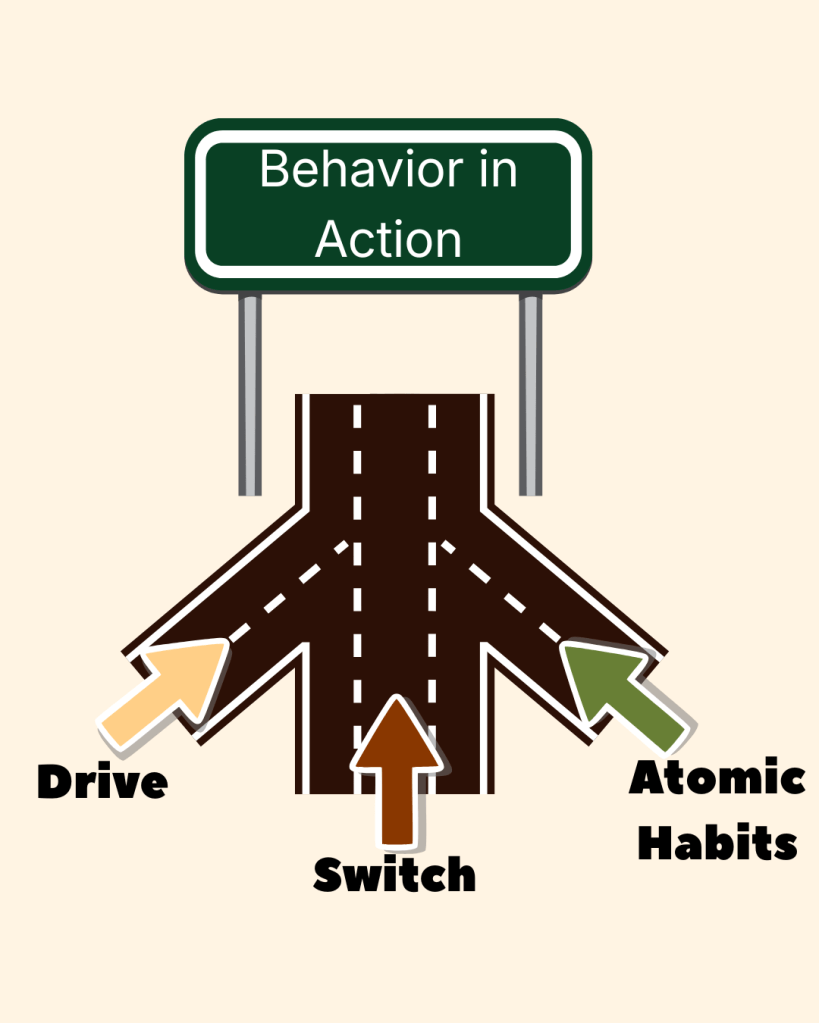
That’s when the idea truly crystallized, becoming the seed for the session I created and shared with colleagues: Driving Atomic Elephants. I built a highly interactive, engaging session for my colleagues, walking them through how I wove these books and their concepts into a mosaic of strategies that helped me grow both professionally and personally. While this post isn’t a recap of that session, it’s the story behind how it came to be.
This post is a thank-you letter to my brain for the way it brought these ideas together into a convergence that helped me grow.
A lot of people say “cross-disciplinary” as if it were a skill. For me, it’s more like a habit of mind. I’m constantly looking for the seams between things: where theories overlap, where metaphors echo each other, where principles rhyme. I even have another post here in my Ponderings that connects two very different concepts in a similar way.
Reading Switch, I learned to map resistance to change without blaming the person.
Reading Drive, I got clearer on what truly fuels action once change begins.
Reading Atomic Habits, I saw how small, concrete adjustments can nudge us from knowing to doing.
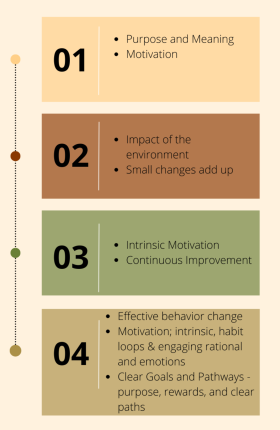
Each book added a layer, but the interplay mattered most. Think about it. Developing habits requires change, and change requires motivation. You can’t have one without the other.
In Switch, you have a destination postcard to show the team, yourself, or a community where you’re headed. In Drive, Pink explains that motivation needs autonomy, mastery, and purpose, and purpose can be that destination postcard. In Switch, scripting the critical moves helps the elephant stay on the path, reducing the rider’s workload. In Atomic Habits, Clear argues that systems are what drive progress. In fact, he writes, “You do not rise to the level of your goals. You fall to the level of your systems.” (p. 27)
Again, the elephant is big and strong. If you don’t have a clear path to the destination, you’re not going to get there.

You get the idea. I could go on and on about how my brain wove these books together.
My Brain Braided These Books. Yours Might Be Braiding Something Else.
I didn’t set out to create and drive an atomic elephant. But I’ve come to trust that when an idea sticks with me, it’s because my brain sees somewhere to use it, even if I don’t yet.
Sometimes I just need time and space for those pieces to bump into each other.
So, here are my questions for you:
What concepts have you stumbled across that seemed separate, but now you realize were part of a larger whole?
Have you ever caught your brain connecting ideas when you weren’t even trying? I’d love to hear about it.
 Jennifer Bosworth's Portfolio