
I love learning and sorting out ideas and concepts in my head. In 2021, I completed a graduate certificate in Learning Design and Technology: Training and Development at UNC-Charlotte. As a higher education department chair and faculty member who teaches predominantly online, I found myself as a student in a fully online program.
I chuckled as I contemplated this particular post because I was going to write about wrestling with concepts and digesting them through the lens of a discussion forum in an online course. I enjoy the challenge of reading and digesting, then repeating the process as I read my classmates’ posts. I must say, in this course we had some lively discussions!
One of the discussion forums we tackled was supporting our peers as they began working through the Human Performance Technology projects. As we delved into the details of our projects and applied what we were learning, I stepped outside the box. Something I enjoy doing! We were discussing evaluation models. Models by the likes of Geis and Smith, Brinkerhoff, as well as Combs and Falletta, among others.
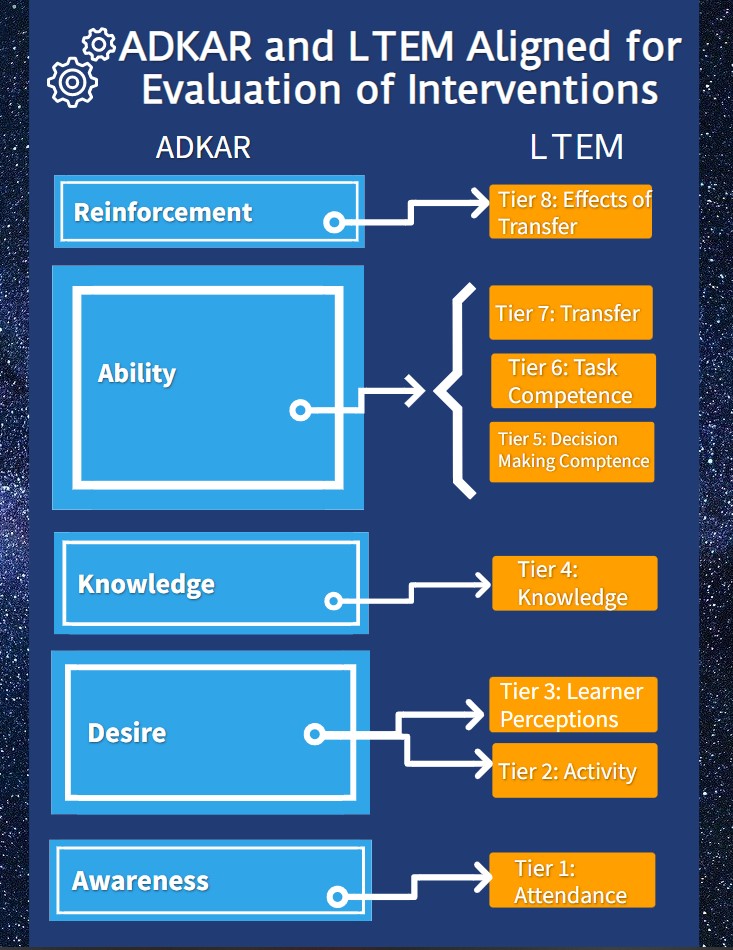
In a moment of reflection, I found myself using a change management model, ADKAR, and Thalheimer’s Learning Transfer Evaluation Model (LTEM) to connect them to evaluating performance improvement projects. It struck me how interwoven learning, performance improvement, and change management are in reality. In this discussion, my classmates were working on a rather abstract performance improvement project aimed at culture change within an organization.
Given the complexity and somewhat abstract nature of the group’s project, which included several interpersonal interventions, I was reminded of Episode 59 of Gary DePaul’s Unlabeled Leadership podcast. Because Thalheimer’s LTEM was an expansion of Kirkpatrick’s four levels, it added some additional nuance that aligned well with the nuanced interpersonal structure of the interventions that particular team was tackling.
Even though LTEM is a learning-evaluation-focused model, it is not unlike Kirkpatrick’s in that it can be shaped to fit broader aspects of performance improvement.
The draw for me was the consideration, particularly in this team’s project, of the transfer and its effects on portions of the model. Since that team’s project focused on performance improvement through a cultural shift, it seemed Thalheimer’s model could be adapted to evaluate the implementation of the interventions the team had developed for their client.
The more I pondered this, the more I thought about a couple of the change management models discussed in the course. In particular, Prosci’s ADKAR model and its applicability to cultural change and change management. Given the team’s focus on the interventions it outlined and its culture change, the ADKAR model can sit alongside LTEM quite nicely.
I envisioned the alignment and used Genialy to build an image of what I was pondering, and this is the result:
 Jennifer Bosworth's Portfolio