

Online Learning: A Valid Delivery Method Being Questioned
Having worked for many years in early childhood, I have experienced the depth and breadth of the general layperson’s understanding of what it is that early childhood professionals do daily. Hint: IT’S NOT BABYSITTING. It’s not even glorified babysitting. Lately, I find myself adding that online teaching is not less than in-person teaching, or in the case of a recent Inside Higher Ed article, it’s not glorified Skype.
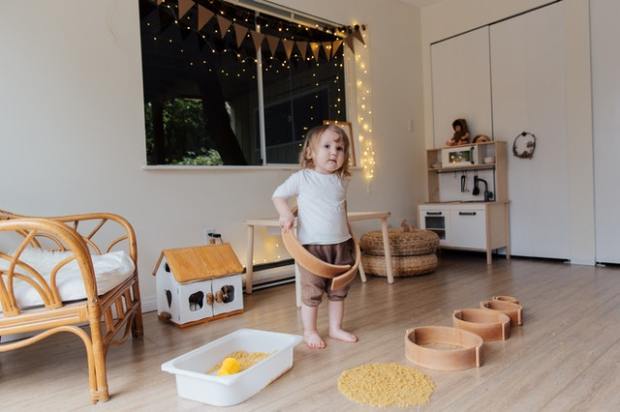
Early Childhood professionals provide enriching experiences that are tailor-fit to meet each child’s individualized needs in the classroom. They monitor the development of each child while working to develop positive, reciprocal relationships with each child and family.
For programs licensed by state oversight entities, there are typically a tremendous number of rules and regulations that these professionals must adhere to at all times above and beyond the developmentally appropriate teaching practices. One component of these rules in North Carolina comes from the Administrative Code 10A NCAC Chapter 9 Child Care Rules. Back in the day, when most administrators, like myself, had print copies of the rules and supporting guidance from the N.C. Division of Child Development and Early Education, we had a hefty tome of double-sided pages that overfilled a four-inch binder.
It feels very ironic to me, in my current role as the Department Chair of Education at A-B Tech, that online education is being thrown down as a ‘less than’ educational experience. I chuckled to myself because higher education faculty are not too terribly often questioned about the validity and efficacy of their work. Higher education has a firm place in the world of education and espouses experts from a myriad of disciplines in their ranks. Yet here I am reading an article where higher education faculty have to ‘prove’ that online learning can be an effective form of instruction. In forums, I read parents incensed that they have to pay full price for their college-aged child’s tuition because, after all, it is online and has less value. These same parents cry for the faculty to be paid a lower wage as a result of the lower value of their child’s post-secondary education. Parents who often have little to no knowledge of the work involved in shifting learning from in-person to online.
Creating course content, whether for a new class or one previously taught in person, “is labor-intensive and requires time, resources and creativity to make the experience resonate with as many students as we can,” she said. However they’re teaching this fall, tenure-track, tenured and contingent faculty members alike “are experts in our field, and the craft of our industry as educators should not be diminished.”
Inside Higher Ed
Teaching online is often more work than teaching in person. Designing a well-planned and thoughtfully intentional course can take hundreds of hours. Once the course is prepared and the term has begun, faculty work diligently to develop relationships with their students in a modality that isn’t always personal. I recently learned that one of my colleagues asks each of his students to schedule a 20-minute “get to know you” virtual meeting so that he can meet each of his students and learn about their goals for the course and for the future. In my courses, I connect their introductions to the course content. In my first class, this term the introductions were to share their favorite childhood book. This offers us an opportunity to learn more about each other. During in-person classes, we can develop relationships more quickly because there is time just before and after class that makes for connections. Live sharing during group discussions and other in-class activities also facilitate relationship building. Being in classes in person makes relationship building more organic.
Online learning is not less than. It is DIFFERENT. We all know that a portion of our population rails against change anytime it appears. So perhaps this is from where some of the angst has surfaced, the unknowns of a new delivery method for many students. However, change is the only constant, and higher education faculty began moving with this change during the spring semester. Since that time, I know colleagues at my college and across the U.S. with whom I have connected have spent a great deal of effort, energy, and time making their online courses better or shifting their traditionally face-to-face classes to online delivery. In fact, all faculty at my college were required to engage in professional development for online instruction. We were then charged with implementing best practices as identified in our professional development into all our online courses from this work. Colleges and Universities across the U.S. have worked to build better online learning experiences for students compared to the emergency remote teaching required of us all back in March. Faculty I’ve interacted with via social media are sharing ideas, asking for help, and seeking the best tools to support the learning outcomes for their disciplines and courses. After all, the lessons presented to students, whether in person or online, are delivered by experts. Post-secondary faculty are experts in their disciplines, and the content of their courses has not changed simply the delivery of that content. The change has been forced upon us all by a worldwide pandemic. Colleges like my own chose in July to make decisions for fall so that faculty had the time to prepare. A-B Tech has only about twenty-five percent of students on campus this fall. This means that the majority of students are engaging in online learning. Because of this shift, my own summer was filled with additional work to build better courses for an even higher quality experience for my students.
As an early childhood professional, the validity of my work has been reduced to babysitting on many occasions. Or I have been told how lucky I was to just play all day. Those who work in my field know this to be the farthest from the truth. There is much professional work done in early care and education settings. Now with the uproar around online education, once again, the validity of my work and the hard work of my colleagues are being questioned by laypeople who do not understand what it means to develop a course for online delivery. As both an early childhood professional and higher education faculty, I am no stranger to having my professionalism and value as an educator questioned. It is, however, no less frustrating. So I say to my non-early childhood higher education faculty colleagues, welcome to the club of having your work viewed as less than. Not a super fun place to be as an educated professional, but we will continue to deliver the expertise of our disciplines through whatever forms our classes may take this semester. I, for one, shall endeavor to educate others about the efficacy, professionalism, and value of online teaching and learning. As our worldwide pandemic is not likely to disappear overnight, it is reasonable to expect that online learning will be here on a larger scale for quite a bit longer.
 Jennifer Bosworth's Portfolio