
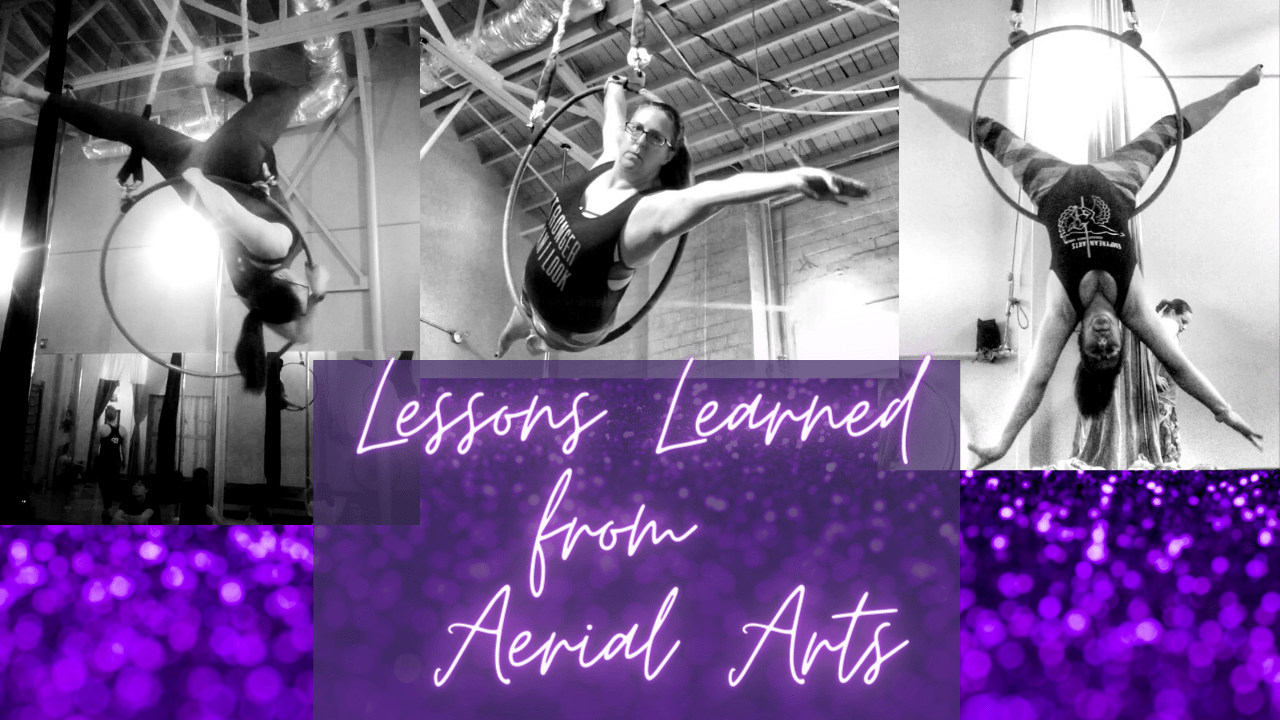
A novice aerialist connects work and aerial arts training.
In a meeting this past week, we were asked to share something humorous that happened to us recently. My humorous moment might have been a wide-eyed, shocking moment for others! Now, mind you, the pandemic threw a considerable barrier to my usual training schedule, which was 4-6 times a week at the studio. I’ve been back at the studio learning and training again for the past few months. I’ve found that my fear factor isn’t quite as strong as it used to be. I’m willing to go for it and trust my skills, trainer, and the mat beneath me. Well, go for it, I did! There’s a “double knee hang drop” move where you slide from balancing on your back to end up hanging by your knees. I’ve done it before, and I wasn’t afraid of it… So I just went for it.
What I failed to calculate, however, was the fact that after 18 months away from regular lyra training, my knee pits forgot how much that hurt, and my hands hadn’t entirely built up the grip strength I once had – the result? I landed in a heap on the mat below my hoop, face-first. I laughed at the moment, and now, looking back at it. This is why our studio has mats and insists that we use them! Safety!
But as I reflected on sharing this with colleagues who didn’t know I trained in the aerial arts, that moment was gasp-worthy for them. However, I learned from that moment, and then I began to ponder what the aerial arts taught me about leadership and work.
Here’s what the aerial arts have taught me about leadership and my professional life.
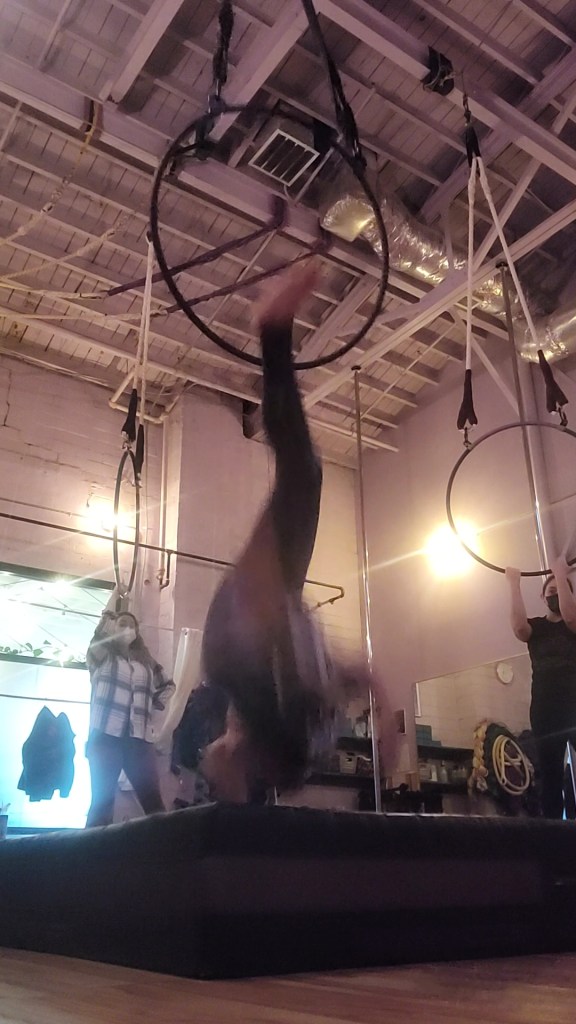
I’ve found that my fear factor isn’t quite as strong as it used to be, I’m willing to simply go for it and trust my skills, my trainer, and the mat beneath me. Well, go for it I did!
Here are the lessons I’ve learned over the past three years of training in the aerial arts and how they apply to my professional life.
- Practice does not make perfect; it fuels improvement, hard things become less daunting, and you build new muscles, whether physical strength or mental muscles.
- Sometimes it is scary, but trust your team: the mat, your spotters, and your trainer are there to support you as you build new skills.
- Supporting others and celebrating their successes brings joy to everyone. In the aerial studio, cheers resound when someone conquers a new and challenging skill. In the workplace, the same should happen!
- If, at first, you fail, try again! Sometimes you have to make a simple adjustment to succeed; other times, it takes time to build new muscles and practice new skills. On the lyra, it can get confusing when you’re hanging upside down trying to figure out where to put your hand and what grip to use. At work, sometimes you have to tweak your process, gain a new perspective, or learn new skills and build that mental muscle once more to succeed.
- Listen to yourself – Trust yourself – But don’t forget to listen and trust your team, your coach/trainer, and others who have been where you are. On the lyra, I need to remember to listen to my body and myself. Listening cues me in on whether I’ve spent all the energy I had for this session, or if I can trust myself to do one more skill. In the end, sometimes it is the people around me who tell me they’ve been where I am, and while it feels intimidating, I go for it. At work, teams build the functionality of a unit or division. Trusting yourself and your team can help you reach your goals. In a career, we do nothing alone – successes are made with the whole.
- Things get turned topsy-turvy at times, so you have to pay closer attention to the circumstances to figure out how to maneuver to the next level. I like to think of this as gaining perspective. When I’m upside down in a hoop, I can often lose track of my right from left or my position relative to the hoop. Sometimes I have to pause, shift in the hoop, or look in the mirrors on the wall to gain the perspective I need to move forward. At work, gaining perspective by working with people outside your unit or team can broaden your view, enabling growth and movement to the next level.
- Be intentional. Know where you are, where you want to go, and make purposeful plans, decisions, and moves. When training on the lyra, I know I want to get better. I have goals for skills I’d like to develop and tricks I’d like to improve. To achieve those things, I have to be intentional in my training. I can’t expect to do new things without building the muscles or foundational skills to achieve my goal. At work, knowing where you are and where you want to go is critical to your satisfaction with your career. Making intentional plans is vital to achieving your goals. I realized I needed to broaden my skill set to move forward in my next career steps.
- Working together can make a beautiful and powerful result. On the lyra, I was fortunate enough to train and plan an aerial performance with a friend. Together, we built a routine that showcased both of our talents. It was raw strength and muscle for her, but do not expect those graceful, beautifully pointed toes. For me, it was gracefulness, lyrical moves, and beautifully pointed toes. Together, we chose a piece of music, trained together and separately, and, in the end, built a fun performance we shared at our Aerial Studio’s student showcase. And would you know, for work, it did great things for us. How, you ask? Well, because we work together day-to-day in the same department, a department of two. This was a fun and engaging way for us to strengthen our team. Take a look at our performance if you want a good laugh!
Working together can make a beautiful and powerful result.
- Growth comes from getting out of what is comfortable! Trying new things builds muscles, new neural pathways, and introduces you to new people, places, things, and ideas. Aerial Arts has introduced me to people I would have never met otherwise. Just like getting on LinkedIn can introduce you to new people, places, and ideas, too!
At the end of the day, we get out of our work and our training what we put into it. Investing time, energy, and passion into our pleasures and professional ventures helps us live the lives that fulfill us and bring us joy. The lyra brings me much joy and offers valuable insights into my professional life.
 Jennifer Bosworth's Portfolio